On April 16, I made my way to the Four Seasons in Washington, DC, where the World Travel & Tourism Council —the world’s largest private sector tourism body— unveiled its 2025 Economic Impact Research, including US tourism performance, to a small group of media professionals.
The stark divergence in the data — global tourism boom in 2025 versus America’s tourism decline — is precisely why WTTC showed up in Washington, said Gloria Guevara, the organization’s returning leader.
But in a room full of travel experts, no one was spelling out in human terms why fewer international tourists are coming to America beyond visa hurdles. And that’s the problem.
The Focus on Data
For most of the briefing, the conversation circled around the numbers — the deficit, the decline, the lost market share. In a nutshell: global tourism had its best year ever in 2025— $11.6 trillion contributed to the world economy — except for the United States.
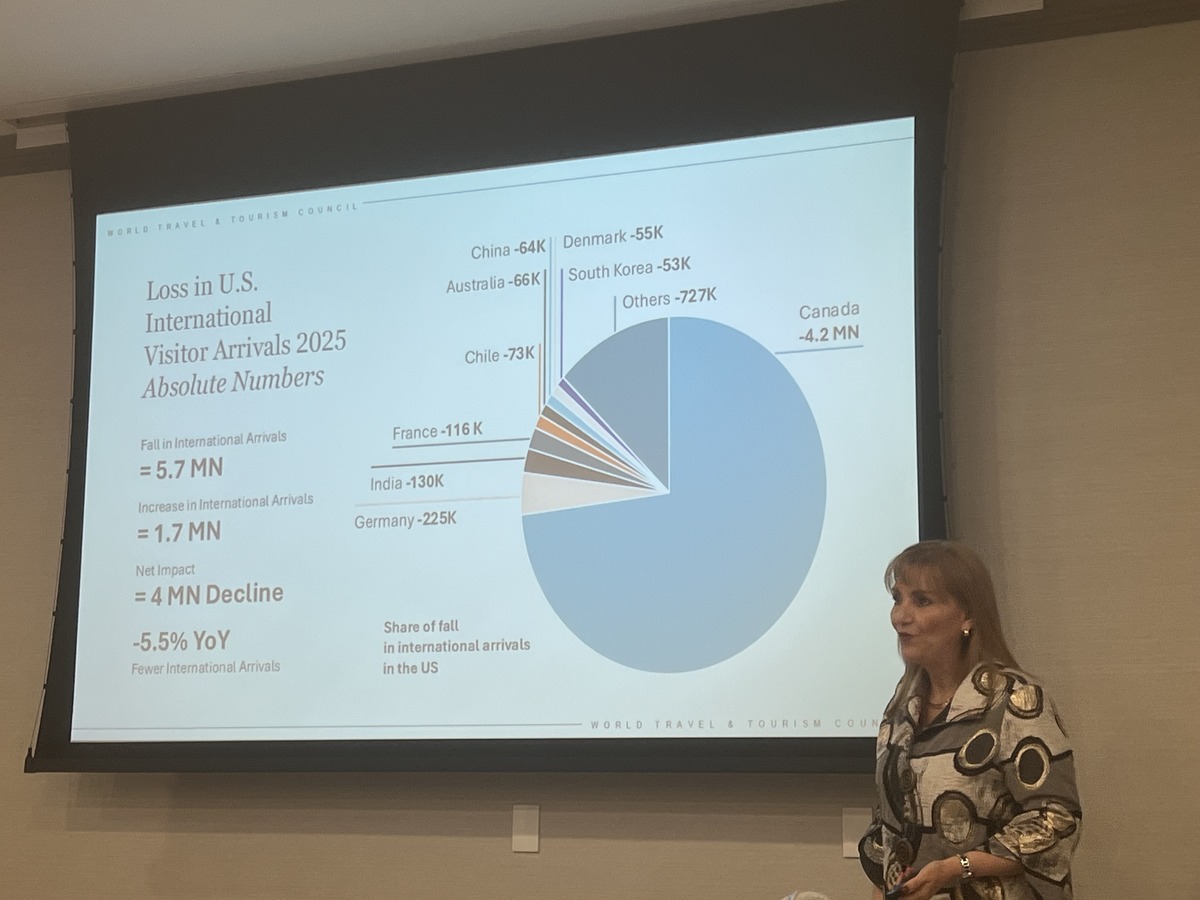
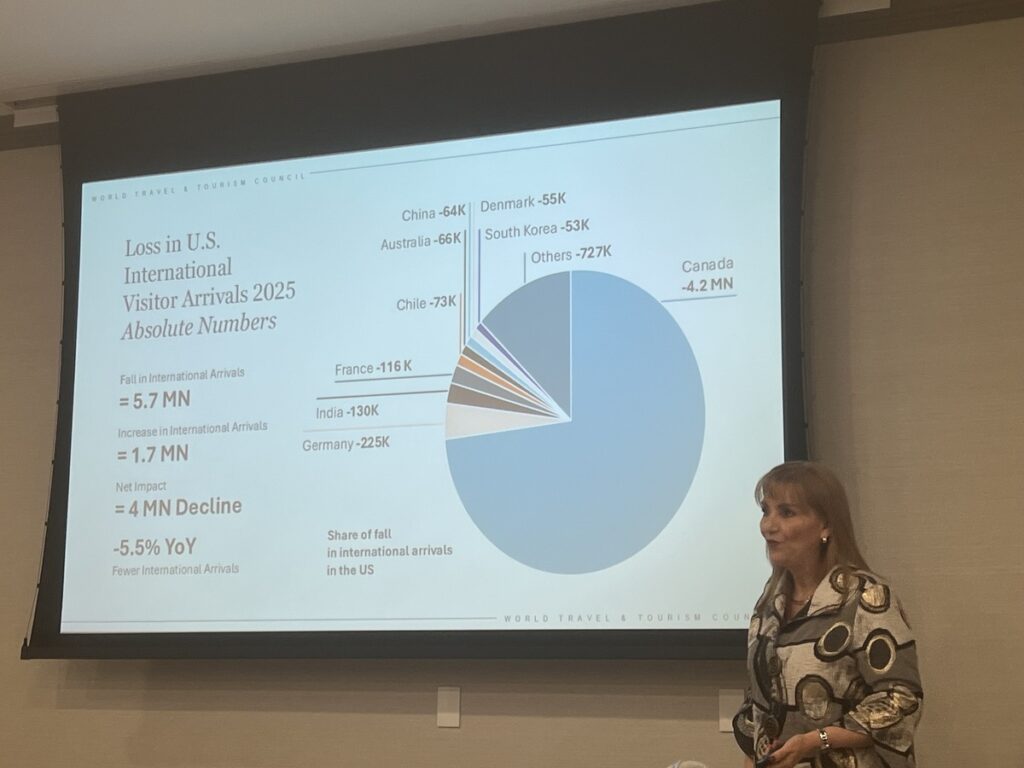
The US lost 4.5 million international visitors year-over-year. Its share of global tourism dropped from 9.4% to 8.7%. International visitor spending fell 4.6%. It was the only country out of 184 analyzed to see inbound visitor spending decline. Meanwhile, China is on a growth path, gaining nine million visitors and experiencing a 10.5% increase in international visitor spending.
Gloria Guevara, head of the WTTC, presents global tourism and US data in Washington DC on April 16, 2026.
The economic damage of America’s new visa and immigrant policies has been widely documented. But the human story behind the why of America’s tourism decline — of communities afraid to travel there, of the racialized fear that’s become a new normal — that conversation is still happening behind closed doors.
Guevara, the first Latina to lead WTTC in 2017, spoke about tackling America’s perception problem in broad terms and pointed to the existence of bright spots like the efficiency of US Global Entry, and the upcoming FIFA World Cup, as part of why the US remains the #1 largest travel and tourism market for now.
Jennifer Wilson-Buttigieg, Head of Travel Policy at Chase Travel — WTTC’s lead research partner — urged the room to tell positive stories about America and its small businesses. The Great American Road Trip campaign. The 2026 FIFA World Cup. America’s 250th anniversary celebrations.
I agree that community and small business storytelling matters, as do stories on seamless travel and technology advancing at airports.
But are we really going to sit here in 2026 and not spell out what’s really driving US tourism decline?
When you don’t name a problem and state your position — especially in the tourism space — you can’t fix it. Since no one was spelling it out during the meeting, I felt compelled to speak up—especially as an Ethiopian American who came to this country as an immigrant and someone who has been a law abiding citizen.
America’s perception problem goes deeper than marketing and the press putting out feel good stories on small businesses.It runs deeper than visa hurdles (those are real, yes).
And it starts with the fact that the US travel industry has remained largely silent on the treatment of its American immigrant communities — the bulk of which make up the US tourism workforce. Silence from the world’s #1 tourism market does not inspire consumer confidence.
Communities of color are being detained, surveilled, deported — brutally handled in full view of the world, shipped to detention centers without due process, even when they are law-abiding green card holders and naturalized citizens. People who are native-born or here legally are afraid to step outside, wondering if they’ll be mistakenly swept up. Visitors are seeing this and hearing of it on social media, and they’re afraid of visiting or turned off, too.
Support for DEI has fallen off and on that, most of the industry has remained silent on it.
Travelers from Latin America, from the Caribbean, from communities with deep ties to this country — and plenty of those who have no ties at all, including Europeans and Canadians — are watching all of this unfold and they don’t want to vacation in a place that treats ordinary people this way based on their origin or the color of their skin. We know this. No campaign changes that sentiment. No grand American road trip itinerary erases what they’re seeing on their screens.
As I said to Gloria Guevara— sure as a Latina leading WTTC, she understands that communities don’t want to see people who look like them dehumanized. She nodded — and when I looked around the room, everyone else was nodding too. Yet no one in the room was saying it out loud.
“At Destinations International, they had the Mayor and the head of the chamber of commerce for Minneapolis speak and reflect on what occurred and why it’s important to come back,” said Chase Travel’s Wilson-Buttigieg. “So I agree there’s starting to be some of those stories out there, but not enough, I agree with you.”
The problem? Destinations International is a private sector membership group and executives attend that event. Global travelers aren’t in that room and hearing from American leaders in the industry saying they care. The media isn’t there, either, if I’m not mistaken.
Guevara then shared her take, that the Trump administration knows because they reached out to WTTC to get some of the latest data. “And that’s a big step,” she said. “They know that spend is declining and China is growing faster than them, they care, and that’s why they have a new envoy to change perception.”
She added that corporate members “are talking to the administration directly — not publicly, but yes, a lot. ”
Speaking behind closed doors and in private does not reassure the traveling public considering where to vacation. If we are an industry that claims to believe in diversity, people-to-people connections, in the transformative power of crossing borders — we must stand for what is right, express that we are inclusive and welcoming to all races and say it to the world as an industry that sits in a divisive political climate. That we support our immigrant workforce, who make up the bulk of tourism labor.
Unfortunately that hasn’t happened. The language continues to focus on economic terms. Or it ignores the reality and says to come visit “America the Beautiful.”
We can all agree this country has incredible places to visit and a bucket list that is endless. But what happens when you can’t go on road trips without a deep sense of fear? Who wants to vacation in a place where you’re not sure what will happen to you or your loved ones unless you have Global Entry?
The messaging from the US travel industry is diplomatic, desensitized and ineffective. And it’s only going to get worse as the public-facing messaging remains absent.
Note, too, that the US posted a $58 billion tourism trade deficit in 2024. By 2025, that figure grew to $72 billion — Americans traveling abroad in record numbers while far fewer people are choosing to come here.
What Needs to Happen
The industry’s instinct to lead with positive narratives while avoiding the harder conversation has long prevented travel and tourism from having the reckoning it needs. Tourism thrives on peace and the perception of welcome. To the outside world right now, the United States is projecting neither. No amount of positive stories will eclipse what is a massive policy problem with a very human face.
You cannot market your way out of a climate of fear. Silence is a choice, no matter how risky speaking up may be — and one that consumers around the world notice and remember.
So what could happen to help start to move the perception needle?
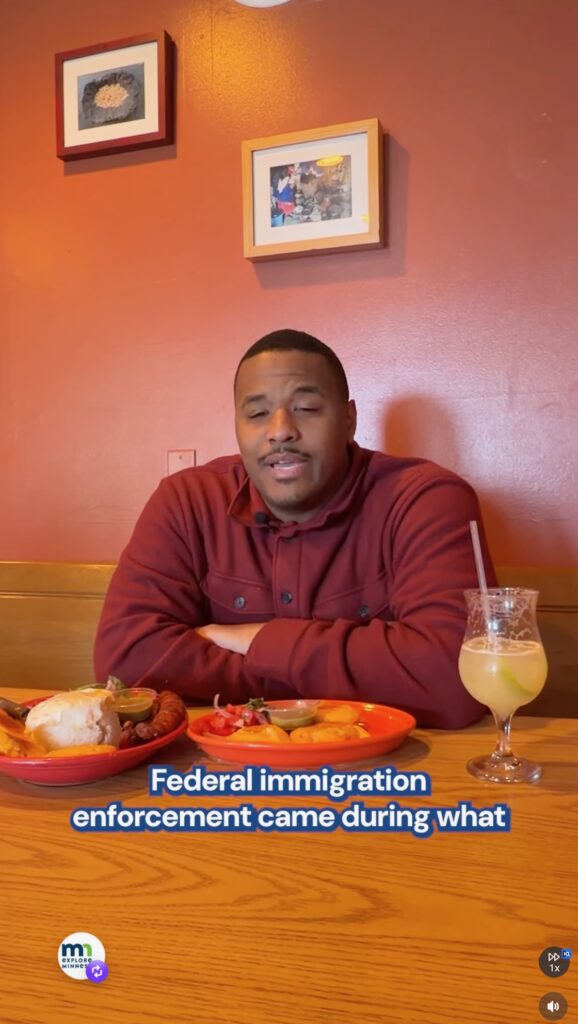
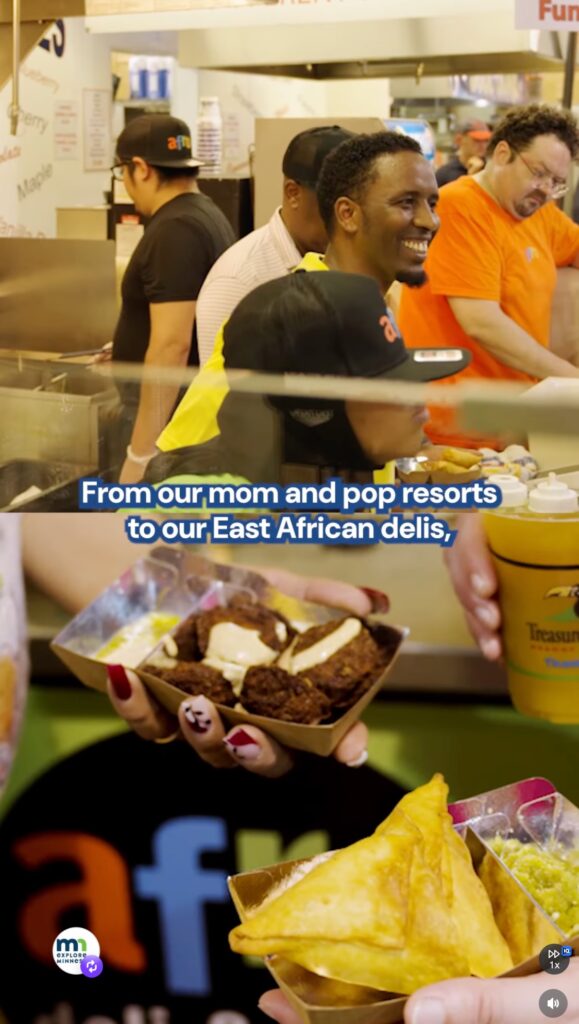
Name it publicly. Not just in private briefings where everyone nods. The acknowledgment has to be on record, in public, with the weight of the industry’s credibility behind it. Take a page out of Explore Minnesota, for example. When ICE occupied the city, their tourism response didn’t hide — they leaned in, reminding the world that Minnesota looks out for its own, that immigrant communities and small businesses are the fabric of the city. They acknowledged ICE activity hurting the local economy, without getting too political. That’s leadership. The rest of the industry should be taking notes.
Use the economic leverage. WTTC, the US Travel Association and the major hotel and airline brands have enormous influence with policymakers. That influence should extend beyond visa processing times — to the climate of fear actively driving visitors away.
Center the human cost. The $12.5 billion in lost visitor spending is significant. But the Ecuadorian father detained before deportation, the Dominican family afraid to visit Miami, the Colombian traveler who chose France instead — those are the real stories of what is being lost.
The travel industry is thriving because more people want to move freely through the world — to explore, connect with others and belong somewhere new. That promise is being broken right now in the United States. And the industry that profits from that promise owes it to the world to say so.
I’ll say this personally, too: after many months of limited bandwidth and focusing on my own family — feeling the weight of ensuring we remain safe even though we are all US citizens or legal residents — I’m now spelling it out loud though I should not have to.
Minnesota’s exemplary messaging after ICE raids.
Leadership requires being bold enough to name the truth — out loud, in public, on social media, with empathy. It can be done, without getting political, and it’s never been more urgent.
After the big brands and the US travel industry bands together in a unified voice to spell out the hurdle in human terms, not visa or TSA language —the Marriotts, the Hiltons, Brand USA and the other huge players in WTTC— then maybe those impactful stories about small businesses will have a trickle down impact. And maybe, the global tourist’s perception may begin to shift.
Until then, travelers will continue to choose other places and the US will continue to lose its grip on global tourism.
Tourism is growing, but it’s also more extractive than ever. World Tourism Day is our reminder to center people over profit.
Manage Consent
To provide the best experiences, we use technologies like cookies to store and/or access device information. Consenting to these technologies will allow us to process data such as browsing behavior or unique IDs on this site. Not consenting or withdrawing consent, may adversely affect certain features and functions.
Functional
Always active
The technical storage or access is strictly necessary for the legitimate purpose of enabling the use of a specific service explicitly requested by the subscriber or user, or for the sole purpose of carrying out the transmission of a communication over an electronic communications network.
Preferences
The technical storage or access is necessary for the legitimate purpose of storing preferences that are not requested by the subscriber or user.
Statistics
The technical storage or access that is used exclusively for statistical purposes.The technical storage or access that is used exclusively for anonymous statistical purposes. Without a subpoena, voluntary compliance on the part of your Internet Service Provider, or additional records from a third party, information stored or retrieved for this purpose alone cannot usually be used to identify you.
Marketing
The technical storage or access is required to create user profiles to send advertising, or to track the user on a website or across several websites for similar marketing purposes.